UPI has made accepting payments simple for businesses.
A customer scans a UPI QR code, makes the payment and moves on. For millions of merchants, it has become part of the everyday checkout experience.
Now, there is an important change to understand.
Under the new UPI MDR rules in 2026, certain merchant payments above ₹2,000 will attract a Merchant Discount Rate, or MDR.
That sounds like a big change. But it does not mean every merchant UPI payment will suddenly have a charge.
Payments to merchants up to ₹2,000 will continue to have zero MDR. Person-to-person UPI transfers will remain free. Eligible small merchants will also continue to receive zero-MDR protection.
In fact, the Ministry of Finance says around 96% of merchant UPI transactions will remain unaffected by the new framework.
So, what actually changes for businesses?
Let’s break it down.
Key Takeaways
UPI is not becoming chargeable for every merchant transaction.
Merchant UPI payments of ₹2,000 or less will continue to have zero MDR.
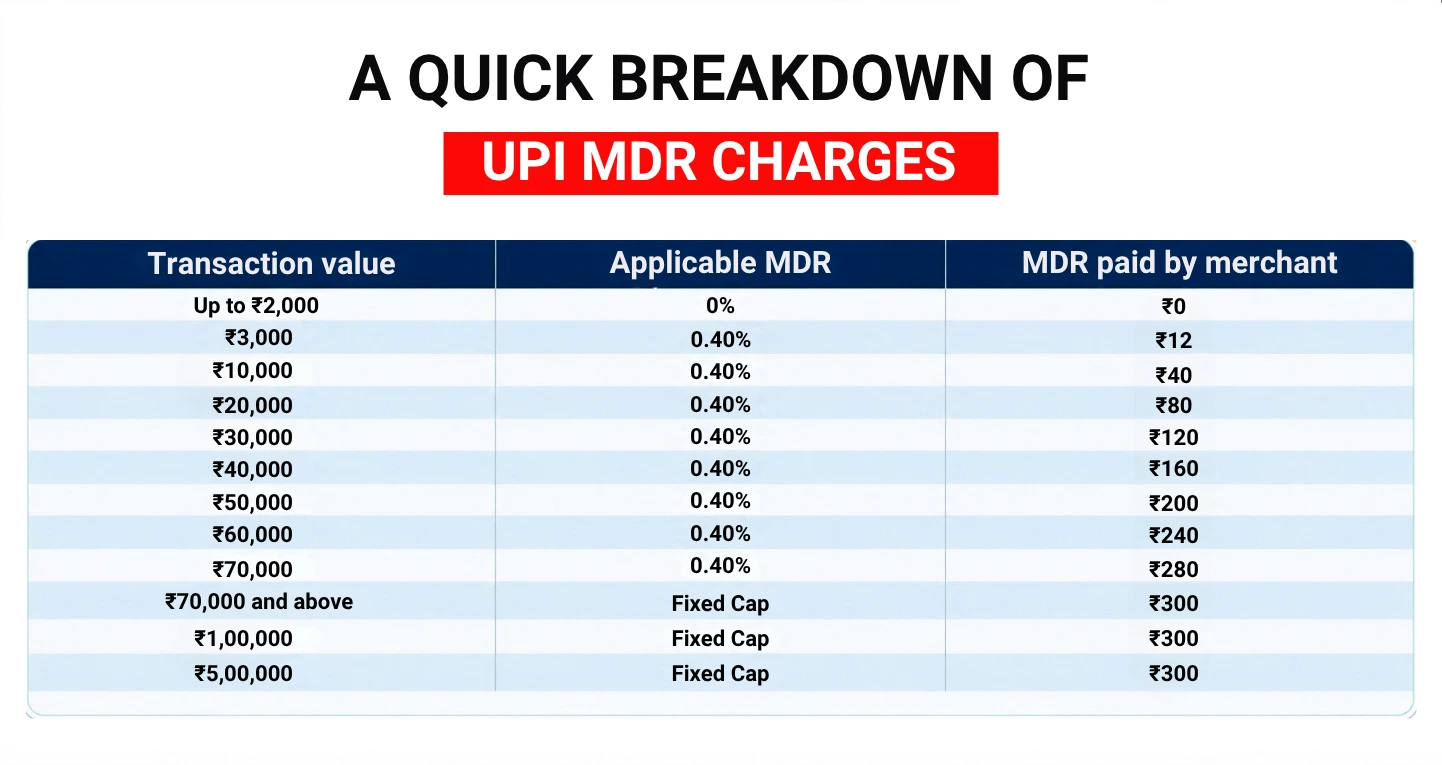
Standard eligible P2M transactions above ₹2,000 will attract 0.4% MDR.
For standard transactions of ₹75,000 and above, MDR is capped at ₹300 per transaction.
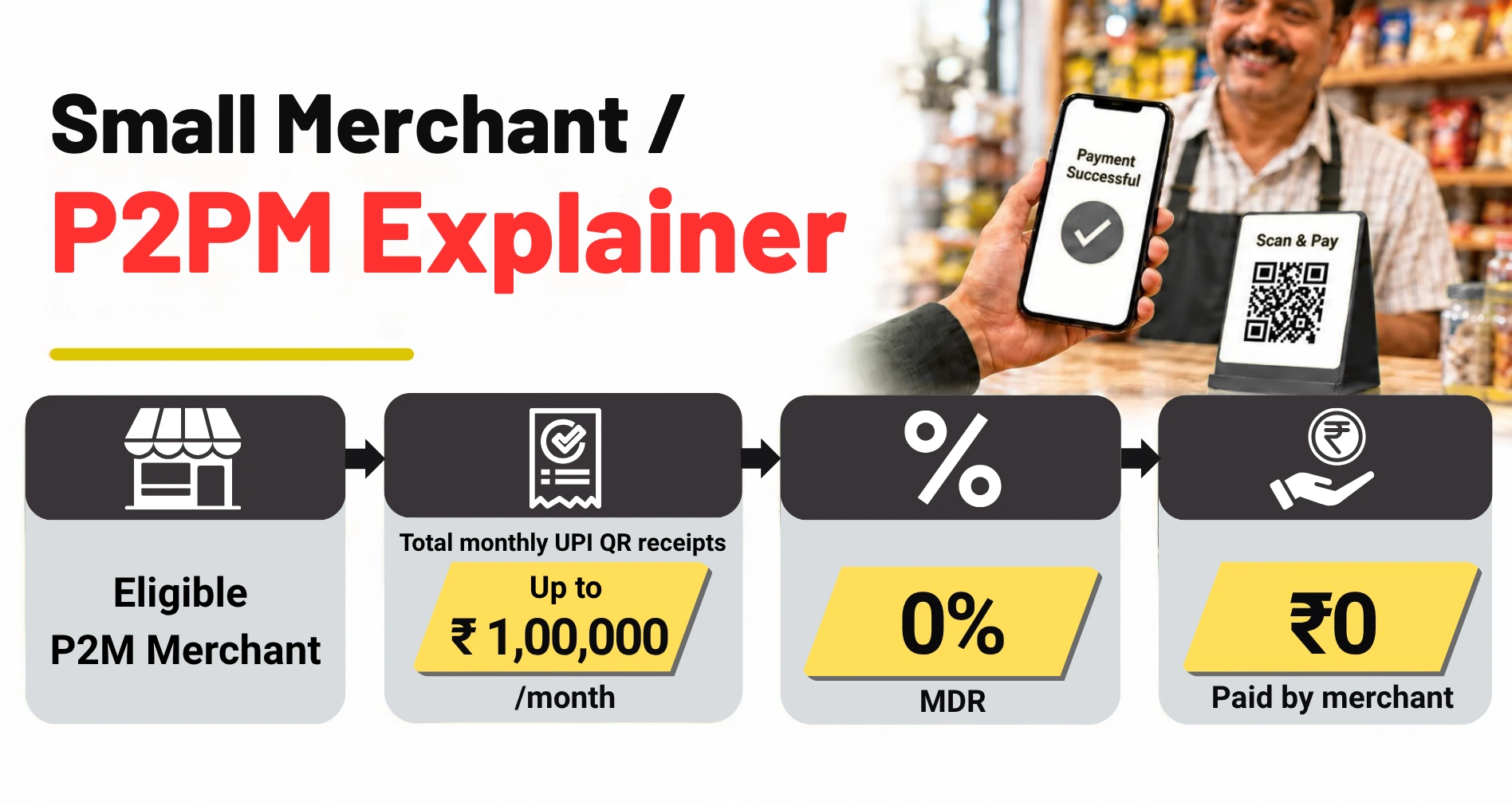
Eligible small merchants receiving up to ₹1 lakh per month through UPI QR under the P2PM category will continue to get zero MDR on all transactions.
Customers will not have to pay MDR for using UPI.
The revised framework was scheduled to come into effect from October 15, 2026.
1. First, What Is MDR?
MDR stands for Merchant Discount Rate.
In simple terms, it is a charge linked to processing certain digital payments received by a business.
It is not a tax collected by the government or NPCI.
The amount is shared among participants involved in processing the payment, including banks, payment service providers and UPI application providers.
Until now, UPI merchant payments have largely operated under a zero-MDR model.
The new framework changes that for a limited set of higher-value merchant transactions.
2. What Are the New UPI MDR Charges in 2026?
The biggest number to remember is ₹2,000.
For standard Person-to-Merchant, or P2M, UPI payments:
Up to ₹2,000Zero MDR
Standard merchant UPI payments
Above ₹2,0000.4% MDR
May apply to eligible transactions
₹75,000 and above₹300 Cap
Maximum standard MDR per transaction
The Ministry of Finance has confirmed these thresholds under the revised framework.
For example, if an eligible business receives a UPI payment of ₹5,000:
Example 1₹5,000 × 0.4% = ₹20 MDR
For a ₹10,000 eligible payment:
Example 2₹10,000 × 0.4% = ₹40 MDR
For very large transactions, the ₹300 cap prevents the charge from continuing to increase beyond the prescribed limit.
3. Does This Mean Every Merchant Will Pay UPI MDR?
No.
And this is where a lot of the confusion around the new UPI charges for merchants begins.
The ₹2,000 rule does not mean every business receiving ₹2,001 will automatically be treated in exactly the same way.
The merchant’s category also matters.
Payments up to ₹2,000 remain free of MDR, and eligible small merchants have a separate zero-MDR protection.
According to government estimates, MDR is expected to apply to only around 4% of merchant UPI transactions. The remaining 96% are expected to stay outside the new charge.
For many shops and businesses where most payments are smaller, the change may therefore have limited day-to-day impact.
4. What Happens When a UPI Payment Is Above ₹2,000?
Let’s take a normal business situation.
A customer makes a ₹1,500 UPI payment.
That transaction remains under the zero-MDR framework.
Now imagine the customer makes an eligible P2M payment of ₹5,000.
That payment falls above the ₹2,000 threshold and can attract the standard 0.4% MDR.
Simple enough so far.
But transaction value is not the only thing that matters.
A merchant may fall under a protected small-merchant category or an industry with a different MDR structure.
So businesses should avoid assuming that one rate applies to every transaction they receive. When accepting UPI and other digital payment methods online, it is equally important to understand the commercial terms of your payment gateway.
5. What About Small Shopkeepers and Small Businesses?
This is probably the most important part of the new rules for smaller merchants.
Eligible small merchants receiving up to ₹1 lakh per month through UPI QR codes under the P2PM category will continue to get zero MDR on their transactions.
The government specifically mentions street vendors, neighbourhood shops and other small businesses under this protection.
So if you run a small shop, do not look at the ₹2,000 threshold alone and assume that every larger payment will now cost you.
Your merchant category matters.
This is also why merchants should know whether their UPI account is classified as P2M or P2PM. Businesses accepting payments through UPI QR solutions should confirm their merchant classification and applicable charges with their payment provider.
6. Will Customers Have to Pay Extra for Using UPI?
No.
The new MDR framework does not introduce a UPI fee for customers.
If someone scans a merchant QR code and pays through UPI, they should not be charged an extra MDR amount for choosing UPI.
Banks have been advised to make sure merchants do not pass MDR charges on to customers. UPI application providers are also prohibited from adding platform fees or hidden UPI charges to individual users under this framework.
Person-to-person UPI transfers also remain completely free, irrespective of the amount transferred.
So for customers, the normal UPI payment experience largely stays the same.
7. Does the 0.4% MDR Apply to Every Industry?
No. Some sectors have separate rates.
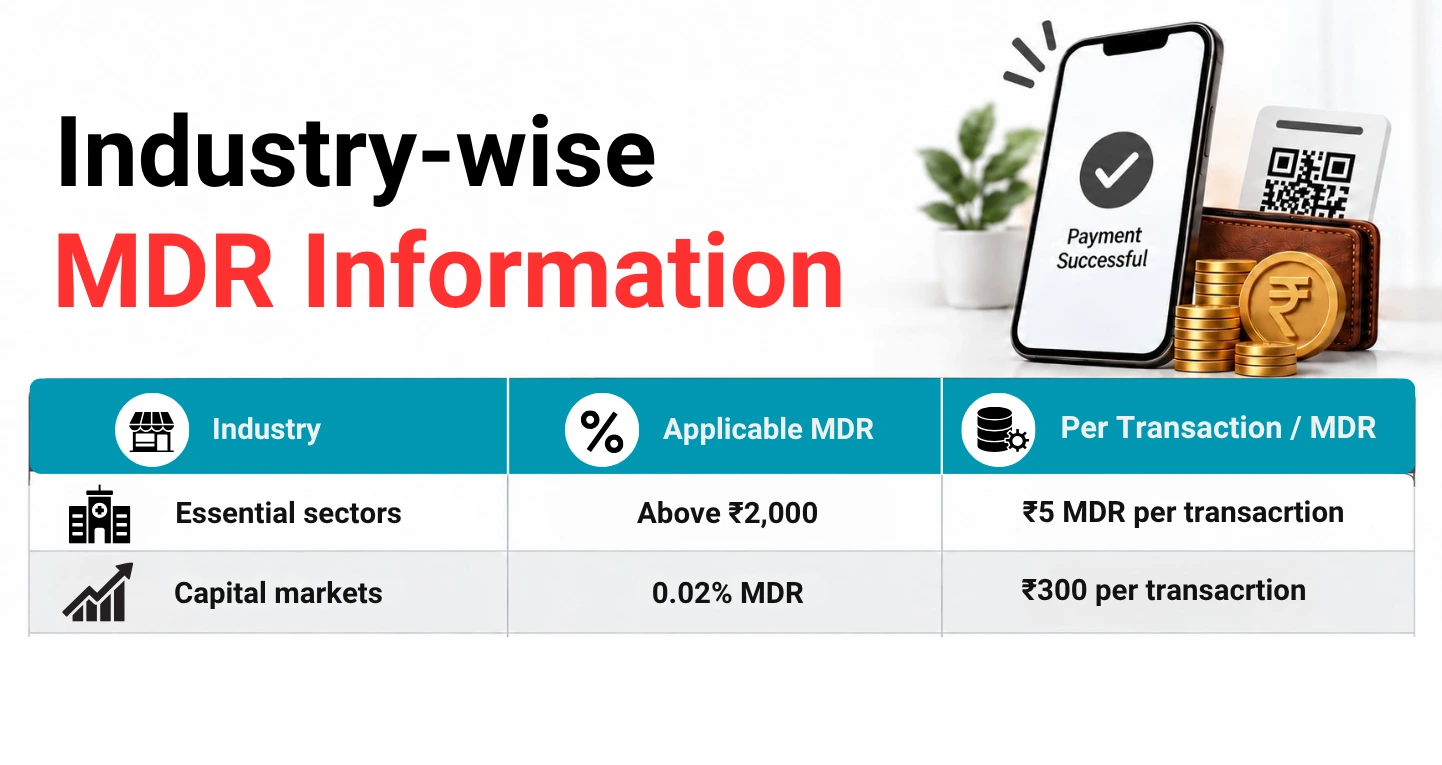
For essential and thin-margin categories such as railways, telecommunications, insurance, fuel and agricultural inputs, transactions above ₹2,000 will attract a flat ₹5 MDR per transaction.
Merchant Category
MDR Structure
Standard eligible P2M
0.4% above ₹2,000, capped at ₹300
Railways, telecom, insurance, fuel and agricultural inputs
Flat ₹5 above ₹2,000
Capital markets
0.02%, capped at ₹300
Eligible P2PM small merchants
Zero MDR under applicable protection
Capital-market payments, including payments related to mutual funds, securities, stockbrokers and dealers, have another structure.
These transactions will attract an MDR of 0.02%, capped at ₹300 per transaction.
So there isn’t one universal UPI MDR rate that every business can apply to itself.
Your business category matters just as much as the transaction amount.
What Does This Actually Mean for Merchants?
For most merchants, the practical impact will depend on one simple thing:
What kind of UPI payments do you normally receive?
If most customers pay ₹300, ₹700 or ₹1,500, there may be little change.
If your business regularly accepts ₹5,000, ₹20,000 or ₹50,000 through UPI, the new rules deserve closer attention.
This is also a good time for businesses to keep a closer watch on:
Transaction amounts
Payment methods
Settlement amounts
Payment deductions
Successful, pending or failed transactions
Merchant category and applicable payment charges
When payments are coming in throughout the day, these details can easily get lost.
A clear view of transactions and settlements makes it easier to understand exactly what was paid, what was deducted and what finally reached the business. A connected payment management platform can help businesses track payment activity, settlements and reconciliation.
UPI Is Not Suddenly Becoming Paid
This is probably the simplest way to look at the change.
UPI itself is not suddenly becoming a paid service.
P2P transfers remain free.
Merchant payments up to ₹2,000 remain under zero MDR.
Eligible small merchants remain protected.
The new MDR applies mainly to specified higher-value merchant payments.
And according to the Ministry of Finance, roughly 96% of P2M UPI transactions are expected to remain unaffected.
For merchants, the real job now is simply to understand where their business falls under the new framework.
If you regularly receive higher-value UPI payments, check your merchant classification and the applicable terms with your bank or payment service provider.
That will tell you far more than a headline saying, “UPI is no longer free.”
Fintech • 5 MINS READ by FiatPe For years, fintech has focused on making payments faster. UPI made transfers instant. QR codes made payment acceptance more accessible. Dashboards made reconciliation easier. But the next shift is not just about speed. It is about payments disappearing into devices and becoming invisible payment infrastructure. This is where […]
Fintech • UPI Payments by FiatPe UPI has made accepting payments simple for businesses. A customer scans a UPI QR code, makes the payment and moves on. For millions of merchants, it has become part of the everyday checkout experience. Now, there is an important change to understand. Under the new UPI MDR rules in […]
In 2025, India’s payment ecosystem stands as one of the most advanced in the world. From QR codes at local stores to instant UPI transfers, digital transactions have become second nature for millions. Yet, amidst this UPI-led revolution, one device continues to hold its ground – the POS machine. Far from being obsolete, POS devices […]
The Global Fintech Fest (GFF) 2025, which drew over 1,00,000 attendees from 100+ countries, set the stage for India’s growing influence in the global digital payments landscape. Within this wave of innovation and collaboration, FiatPe demonstrated how technology and inclusivity can shape the future of payments. FiatPe’s reputation for driving fintech innovation made it a […]


 Back